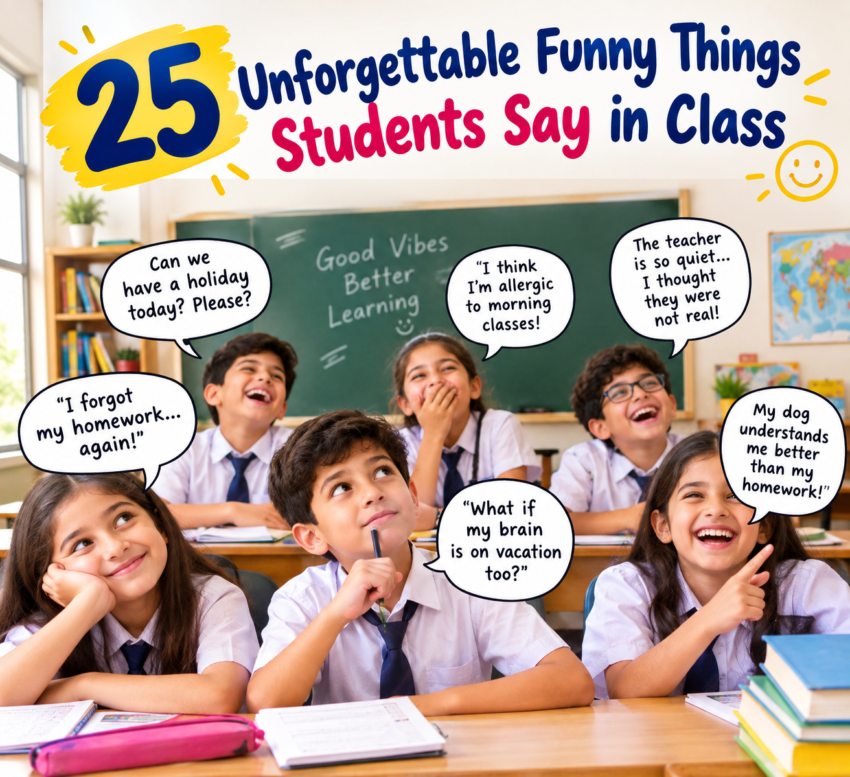
A classroom can be a serious place, but it is also full of unexpected moments. funny Children ask unusual questions, give surprising answers, and sometimes say exactly what is on their minds. A simple question from a teacher can turn into a moment that everyone remembers.
Some comments are funny because they are completely unexpected. Others become amusing because a child gives an answer with total confidence. These little moments can make an ordinary school day much more memorable.
Here are 25 playful examples of things a funny student might say during a lesson.
“I Know the Answer, But I Forgot It”
The teacher funny asks an easy question. A student confidently raises a hand and says, “I know the answer. I just forgot it.”
The room goes quiet for a second.
It is hard not to smile at such honesty. At least the student was confident before the memory disappeared.
“Can We Have This Lesson Tomorrow?”
A teacher begins explaining a difficult topic.
One child listens carefully and then asks, “Can we learn this tomorrow instead?”
It sounds like a clever way to request more time. The teacher may not agree, but the question certainly gets attention.
“My Pencil Is Taking a Break”
The class is working on an exercise. One student has written nothing.
When asked why, the child points at the pencil and says, “My pencil is taking a break.”
That pencil must have had a very busy morning.
“I Did My Homework in My Head”
A teacher checks the homework and finds an empty notebook.
The student quickly explains, “I did it in my head.”
It is a creative answer. Unfortunately, homework usually needs to leave the head and reach the notebook too.
“Is This Going to Be on the Test?”
The teacher has just started explaining a new subject.
Before the explanation is even finished, someone asks, “Is this going to be on the test?”
It is one of those questions that can arrive before the lesson has properly started.
“I Was Listening With My Eyes Closed”
A teacher notices a student looking very sleepy.
When asked whether the lesson was being followed, the student replies, “Yes. I was listening with my eyes closed.”
That is certainly one way to describe a classroom nap.
“My Dog Ate the Homework”
The classic homework excuse never seems to disappear.
A student says the homework is missing because the family dog ate it.
The teacher asks, “Really?”
The student pauses and adds, “Well, maybe he only looked at it.”
At least the story received a quick update.
“Why Does the Clock Move So Slowly?”
During a long lesson, a student looks at the wall clock.
“Why does the clock move so slowly at school?”
It is a question many children may quietly understand.
Five minutes can feel very different when you are waiting for the final bell.
“Can I Borrow Your Brain?”
A student looks at a friend’s work and asks, “Can I borrow your brain for a minute?”
The friend laughs.
It may not be possible to lend a brain, but sharing an idea can certainly help.
“I Thought This Was a Free Period”
The teacher walks into the room with books and notes.
A student looks surprised and says, “I thought this was a free period.”
The teacher looks at the timetable.
The student looks at the teacher.
The lesson continues.
“My Answer Is Almost Correct”
A teacher says an answer is incorrect.
The student quickly responds, “It is almost correct.”
That tiny word “almost” can make a wrong answer sound much more hopeful.
“I Was About to Start”
The teacher asks why the worksheet is still blank.
The student replies, “I was about to start.”
The teacher asks, “When?”
The student thinks for a moment.
“Very soon.”
Sometimes the hardest part of homework is deciding when to begin.
“Can I Get Extra Marks for Creativity?”
A student gives an unusual answer to a question.
The teacher says it is not correct.
The student asks, “Can I get extra marks for creativity?”
The answer may still be no, but the attempt deserves a smile.
“My Notebook Has No Idea Either”
A teacher asks the student to find an answer in the notebook.
The student turns several pages and says, “My notebook has no idea either.”
At least the notebook and the student are working as a team.
“I Was Saving My Energy”
The class is asked to complete ten questions.
One student has finished only two.
When asked about the rest, the answer is, “I was saving my energy.”
That sounds sensible until the teacher points out that writing usually requires less energy than running a marathon.
“I Forgot Which Page We Are On”
The teacher says, “Open your books to page 42.”
A student asks, “Which book?”
It turns out the student has brought three books but is holding the wrong one.
A simple page number suddenly becomes a complicated problem.
“Can You Explain It in Easy Language?”
The teacher gives a detailed explanation.
A student raises a hand and says, “Can you explain it in easy language?”
It is actually a useful request. Sometimes a complicated idea becomes much clearer when someone explains it in simple words.
“I Was Thinking About the Answer”
The teacher asks a question.
The student remains silent for a long time.
Finally, the child says, “I was thinking about the answer.”
The teacher asks, “And?”
The student replies, “I am still thinking.”
At least there is no pretending that the answer has been found.
“Does This Count as Exercise?”
The teacher asks everyone to stand up and stretch.
One student looks around and asks, “Does this count as exercise?”
The teacher says yes.
The student smiles and says, “Good. I was worried.”
Even a small stretch can apparently become a fitness achievement.
“I Have a Very Important Question”
A student raises a hand with a serious expression.
The teacher says, “Yes?”
The student asks, “When is lunch?”
Everyone knows lunch is important, but perhaps that was not the question the teacher expected.
“My Calculator and I Disagree”
During a mathematics lesson, a student checks an answer several times.
Finally, the child says, “My calculator and I disagree.”
That creates a new problem.
Someone has to decide who is correct.
Usually, the calculator has a stronger case.
“Can We Start Again?”
A student answers a question incorrectly.
Instead of giving up, the child says, “Can I start again?”
That may sound funny in the moment, but it is also a good attitude. Mistakes are part of learning.
“I Know What You Mean”
The teacher explains a difficult idea.
A student nods seriously and says, “I know what you mean.”
The teacher asks, “Can you explain it?”
There is a long pause.
The student says, “Not yet.”
That is probably the most honest response possible.
“Was That a Trick Question?”
A teacher asks a simple question.
The student gives the wrong answer and then immediately asks, “Was that a trick question?”
Sometimes people blame the question before blaming their answer.
It is a surprisingly common reaction when someone gets caught off guard.
“The Bell Should Get a Trophy”
The final bell rings after a long lesson.
A student smiles and says, “The bell should get a trophy.”
Everyone understands the feeling.
The bell may be one of the most popular sounds in the school building.
Why Do Classroom Comments Become So Memorable?
Children often speak without spending too much time planning their words. That natural honesty can lead to unexpected comments.
Another reason is timing. A simple sentence can become much funnier when it arrives at exactly the right moment.
Sometimes the wording is amusing. Sometimes the child’s confidence makes the moment special. A completely incorrect answer can still be memorable when it is delivered with a serious face.
These moments are not really about making fun of anyone. They are small examples of how naturally funny everyday conversations can be.
The Best Classroom Moments Feel Natural
The funniest comments are usually not carefully prepared. They happen while a lesson is moving along.
A child may misunderstand a question. Another may give an unusual explanation. Someone else may ask a question that everyone else was secretly thinking about.
That is what makes these moments enjoyable.
They show that a school day is not only about books, homework, and tests. It is also about conversations, friendships, mistakes, questions, and memories.
What Can Teachers Learn From These Moments?
Unexpected comments can sometimes show what children really understand about a topic.
If several students are confused about the same idea, a teacher can explain it in a different way. A surprising question may even lead to a useful classroom discussion.
A little humor can also make the learning environment feel more relaxed. Students may feel more comfortable asking questions when they know that every question does not have to sound perfect.
Of course, classroom rules still matter. Humor works best when everyone is treated with respect.
Final Thoughts
School memories are often built from small moments.
A strange answer, an unexpected question, a creative excuse, or a perfectly timed comment can become something classmates remember for years.
The 25 examples above show why everyday classroom conversations can be so entertaining. They are simple, harmless, and easy to understand.
The next time a child says something unexpected during a lesson, it may be worth remembering. Years later, that little comment could become one of those school stories everyone still talks about.